PACKAGING GUIDE
Custom Jewelry Packaging MOQ: A Practical Guide for Brands
Compare standard and lower starting quantities for custom jewelry boxes, paper bags, pouches, displays and packaging accessories.
DOMZO PACKAGING GUIDE · 10 MIN READ
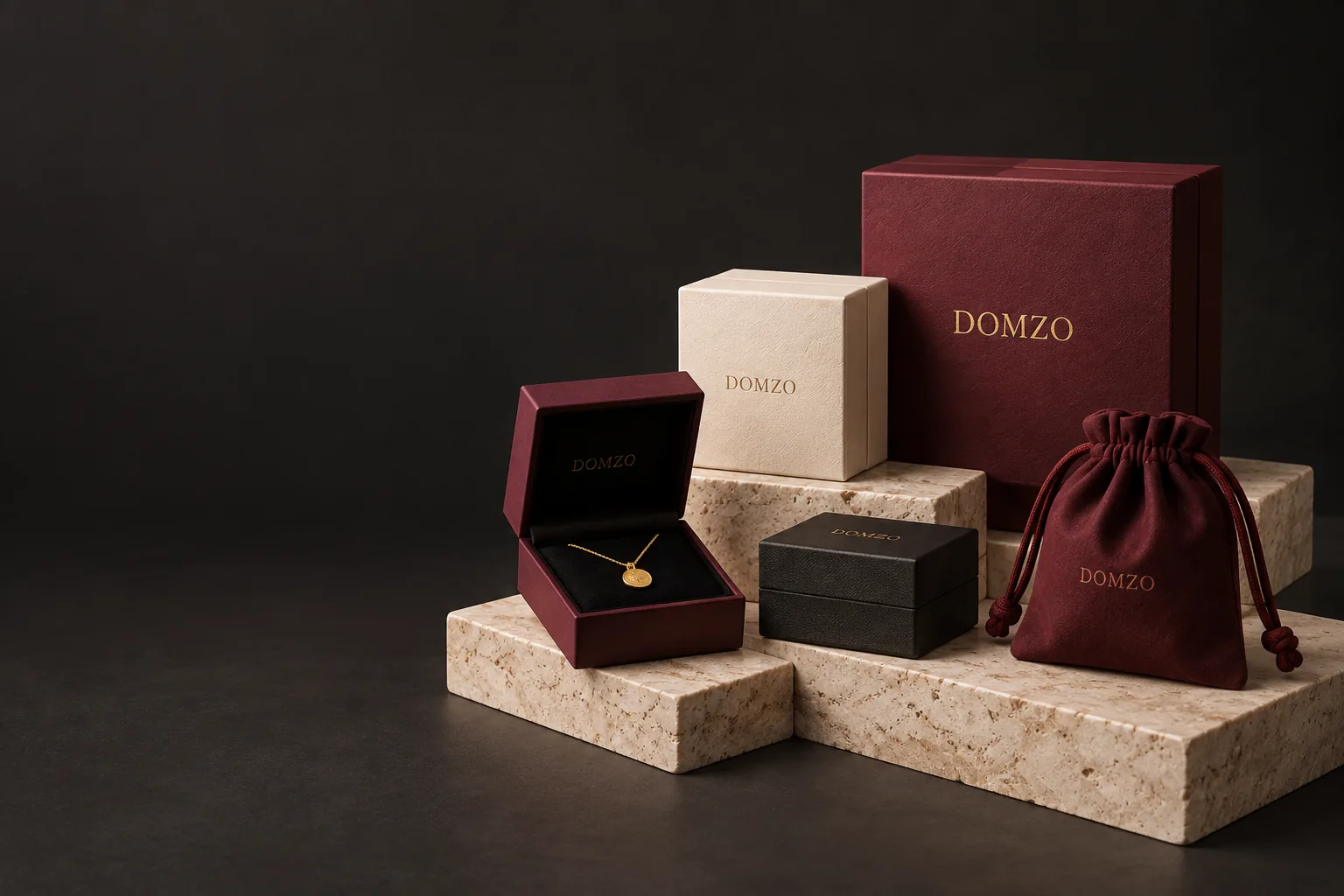
Minimum order quantity is one of the first questions jewelry brands ask when planning custom packaging. The short answer is that MOQ depends on the packaging type, structure, size, material and branding method.
At DOMZO, standard MOQs range from 30 rolls for ribbon and 50 units for jewelry displays to several thousand units for fully customized paper bags and fabric pouches. Lower starting quantities may also be possible for selected boxes, bags and pouches, but the unit price will be higher.
This guide explains how custom jewelry packaging MOQs work, why they vary and what information you should prepare before requesting a quote.
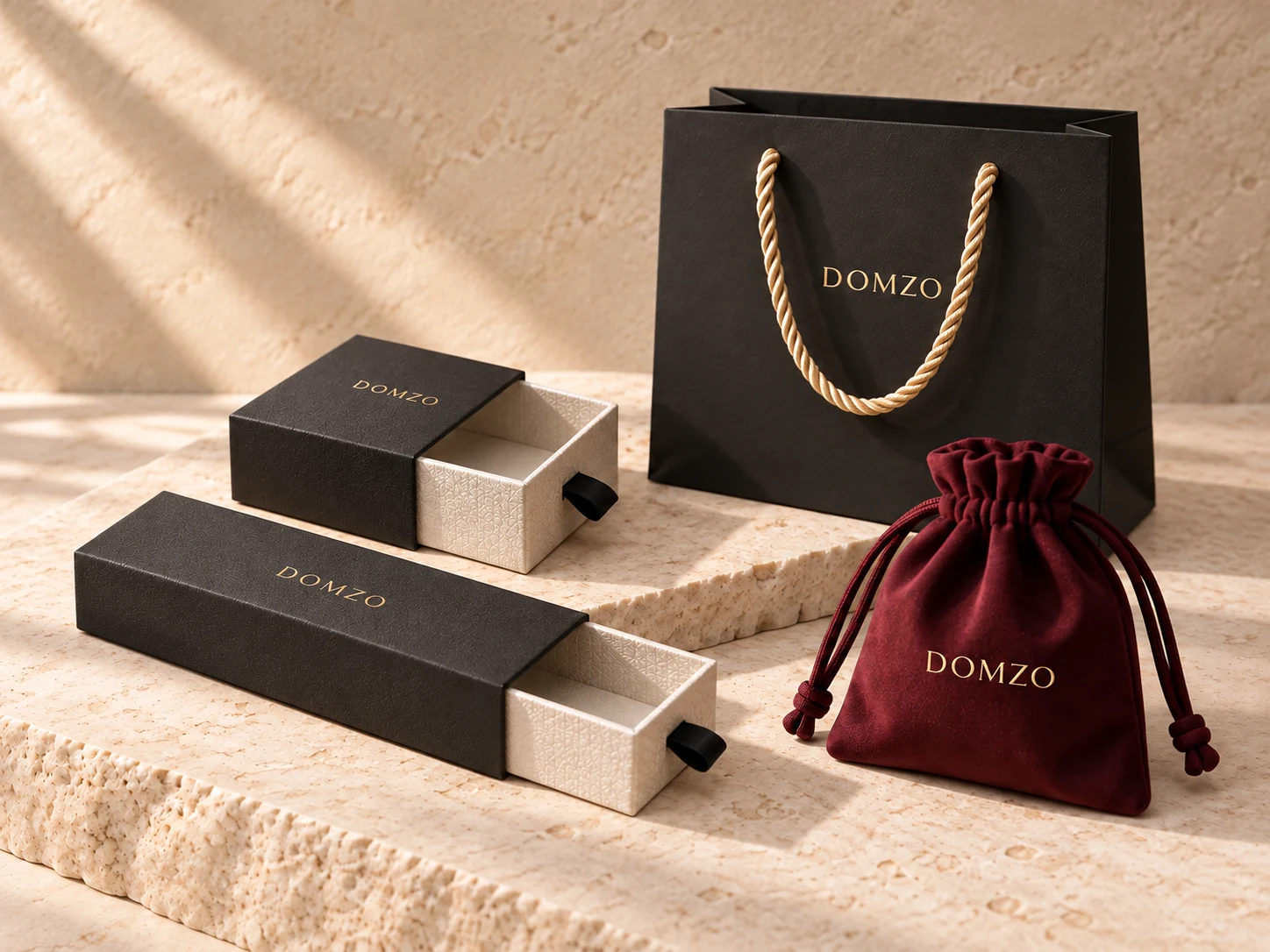
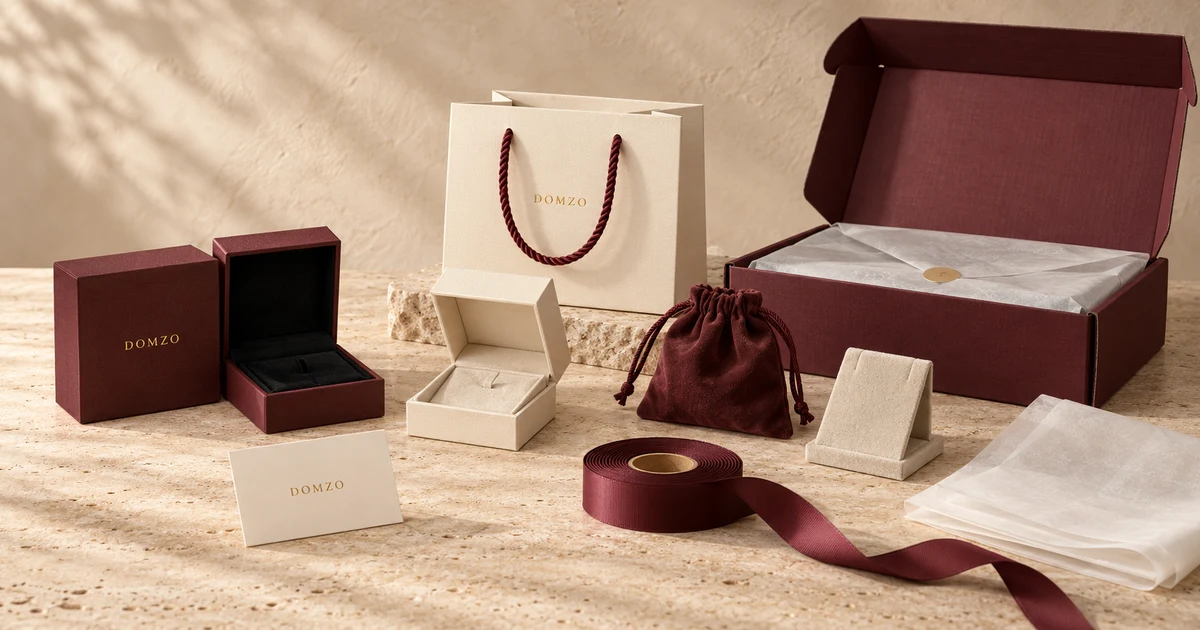
A coordinated packaging collection can include boxes, bags and pouches, with MOQ calculated for each product specification.
What Does MOQ Mean in Custom Jewelry Packaging?
MOQ means minimum order quantity. It is the smallest production quantity a manufacturer can normally produce for one packaging specification.
For custom packaging, MOQ is usually calculated per style and per size. A ring box and a necklace box are therefore normally treated as two separate items, even when they use the same color and logo. Different colors, materials or logo treatments may also create separate production requirements.
This matters when planning a collection. Ordering 1,000 boxes across four different sizes does not necessarily mean 250 pieces of each size can be produced at the same unit price. Each size may require its own cutting die, insert, material preparation and production setup.
DOMZO Custom Packaging MOQ at a Glance
The following quantities are practical starting points for quotation. Final MOQ is confirmed after the structure, size, material, logo finish and packing requirements have been reviewed.
| Packaging type | Standard MOQ | Possible lower starting quantity |
|---|---|---|
| Rigid jewelry boxes | 1,000 per style and size | From 500, with a higher unit price |
| Folding paper boxes | 2,000 per style and size | From 1,000, with a higher unit price |
| Paper bags | 3,000 per style and size | From 1,000, with a higher unit price |
| Fabric pouches | 2,000 per style and size | From 1,000, with a higher unit price |
| Jewelry displays | 50 per style and size | Confirmed by design |
| Ribbon | 30 rolls | Confirmed by specification |
| Tissue paper | 5,000 sheets | Confirmed by print and size |
| Mailer boxes | 1,000 | Confirmed by size and print |
| Cards | 1,000 | Confirmed by size and finish |
These quantities are guidelines rather than one universal rule. A straightforward design using available materials may be easier to produce at a lower quantity than a highly specialized structure or uncommon material.
Explore DOMZO's custom jewelry boxes, paper bags, fabric pouches and jewelry displays to compare the main packaging categories.
Can You Order Less Than the Standard MOQ?
Yes. Selected projects can begin with a lower production quantity:
- Rigid boxes may start from 500 pieces per style and size.
- Folding paper boxes may start from 1,000 pieces per style and size.
- Paper bags may start from 1,000 pieces per style and size.
- Fabric pouches may start from 1,000 pieces per style and size.
The unit price will be higher than it would be at the standard MOQ. Feasibility also depends on the selected materials, dimensions, construction and logo process, so the lower quantity must be confirmed for the individual project.
A lower starting quantity can make sense for a new collection, a market test or a brand launching its first custom packaging. For an established product line, the standard MOQ usually provides better cost efficiency.
Why Does a Lower Quantity Cost More Per Unit?
Several production costs apply whether a factory makes 500 pieces or several thousand pieces. At a lower quantity, those costs are divided across fewer finished units.
Production setup
Cutting dies, printing plates, foil stamping dies, machine setup and color preparation create initial costs before full production begins.
Material purchasing
Special paper, fabric, ribbon, board, magnets and insert materials may have supplier minimums. Small production runs can leave unused material or require purchasing through a less efficient route.
Manual work
Many premium jewelry boxes and pouches require hand assembly, wrapping, gluing, sewing, fitting or inspection. Small runs still need the same workflow and quality controls.
Custom inserts and finishes
Foam, velvet, microfiber and paperboard inserts must fit the jewelry and the box. Hot foil, embossing, debossing, screen printing and other logo treatments also require separate setup.
For this reason, a lower MOQ reduces the total number of units you must purchase, but it does not reduce every setup cost in the same proportion.
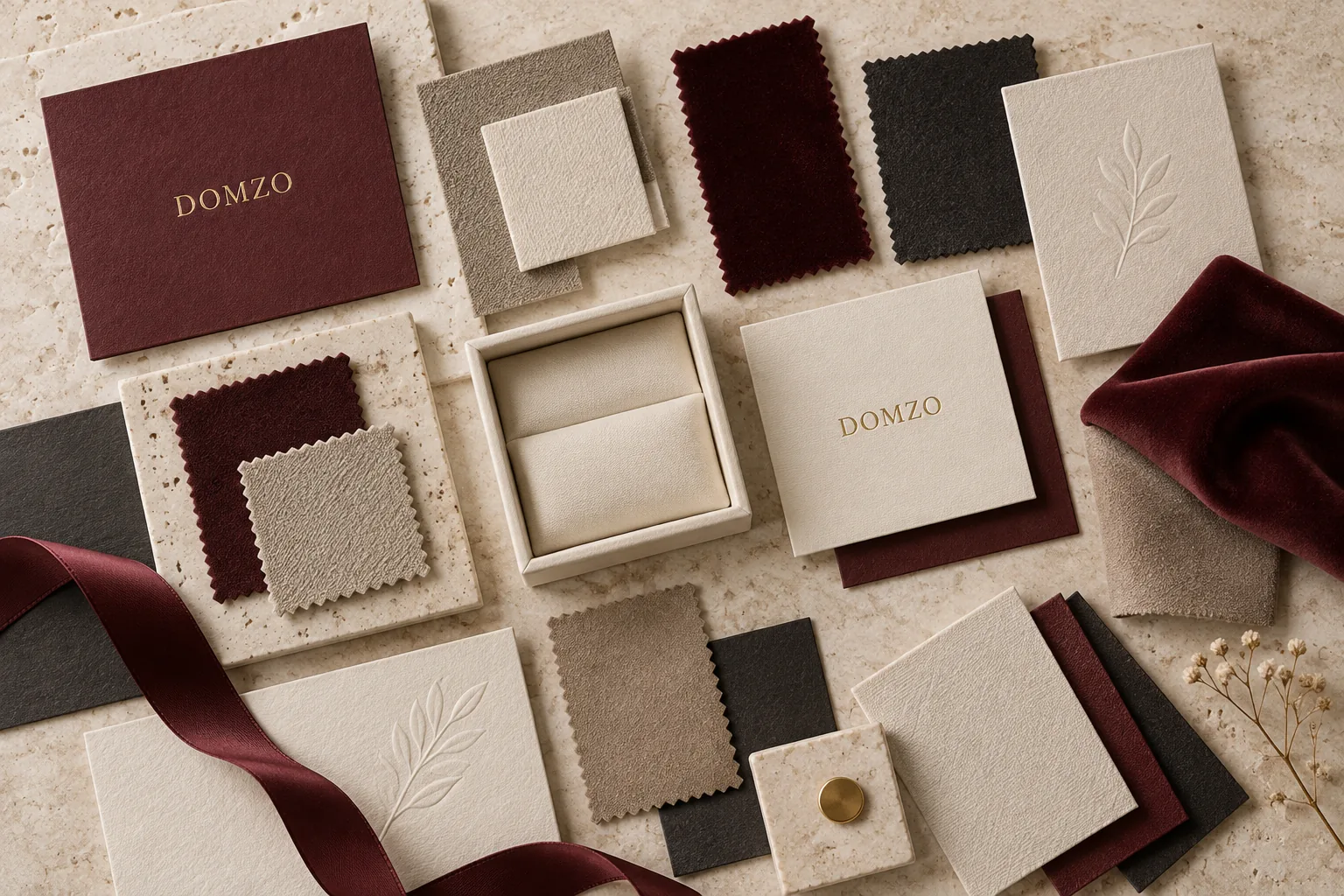
Materials, colors, inserts and logo finishes all affect the production setup and final MOQ.
Is MOQ Calculated Per Design, Color or Size?
In most cases, MOQ is calculated per style and per size. Color and artwork variations may also be counted separately.
For example, a brand may need:
- 1,000 burgundy ring boxes
- 1,000 burgundy necklace boxes
- 1,000 cream ring boxes
Even though the boxes belong to one collection, they represent different size and color combinations. They should be listed separately when requesting a quote.
If several products use the same material, logo finish and color, DOMZO can review the complete packaging program and identify where materials or processes can be coordinated. This can improve consistency and may reduce unnecessary setup, but it does not automatically combine all items into one MOQ.
What Affects the Final MOQ?
The most important factors are:
- Packaging structure: rigid boxes, folding boxes, drawer boxes, magnetic boxes, bags and pouches use different production methods.
- Finished size: each size may require its own tooling, pattern or insert.
- Material: standard papers and fabrics may be easier to source than uncommon colors, textures or specialty materials.
- Logo finish: foil stamping, embossing, debossing, screen printing and full-color printing have different setup requirements.
- Insert construction: ring, earring, necklace and bracelet inserts need different cuts and support structures.
- Color matching: custom Pantone colors or dyed fabrics may require larger material runs.
- Packing method: individual bags, tissue wrapping, protective corners, labels and carton requirements affect labor and materials.
Sharing these details early gives you a more accurate MOQ and price instead of a broad estimate that may change later.
Should a New Jewelry Brand Choose the Lowest MOQ?
The lowest possible MOQ is useful when cash flow, storage or demand is uncertain. However, the lowest total order value does not always produce the best packaging cost.
Before choosing a quantity, compare:
- Expected sales for the next 6–12 months
- Number of jewelry sizes or SKUs
- Storage space
- Packaging unit cost at different quantities
- Likelihood of changing the logo, color or product dimensions
- Shipping cost per unit
If one box size can support several jewelry products through a well-designed insert, it may be more efficient than ordering many low-volume box sizes. If the fit or presentation would suffer, separate sizes may be the better decision.
Sample and Production Timing
A pre-production sample allows you to check the structure, dimensions, materials, logo and insert before bulk production.
DOMZO's typical sampling time is 7–10 days. Typical production lead times are:
- Boxes: 25–30 days
- Fabric pouches: 15–20 days
- Paper bags: 15–20 days
- Jewelry displays: 25–30 days
- Packaging accessories: 20–25 days
Timing can vary with the quantity, material availability, complexity and required revisions. Shipping time is quoted separately according to the destination and delivery method.
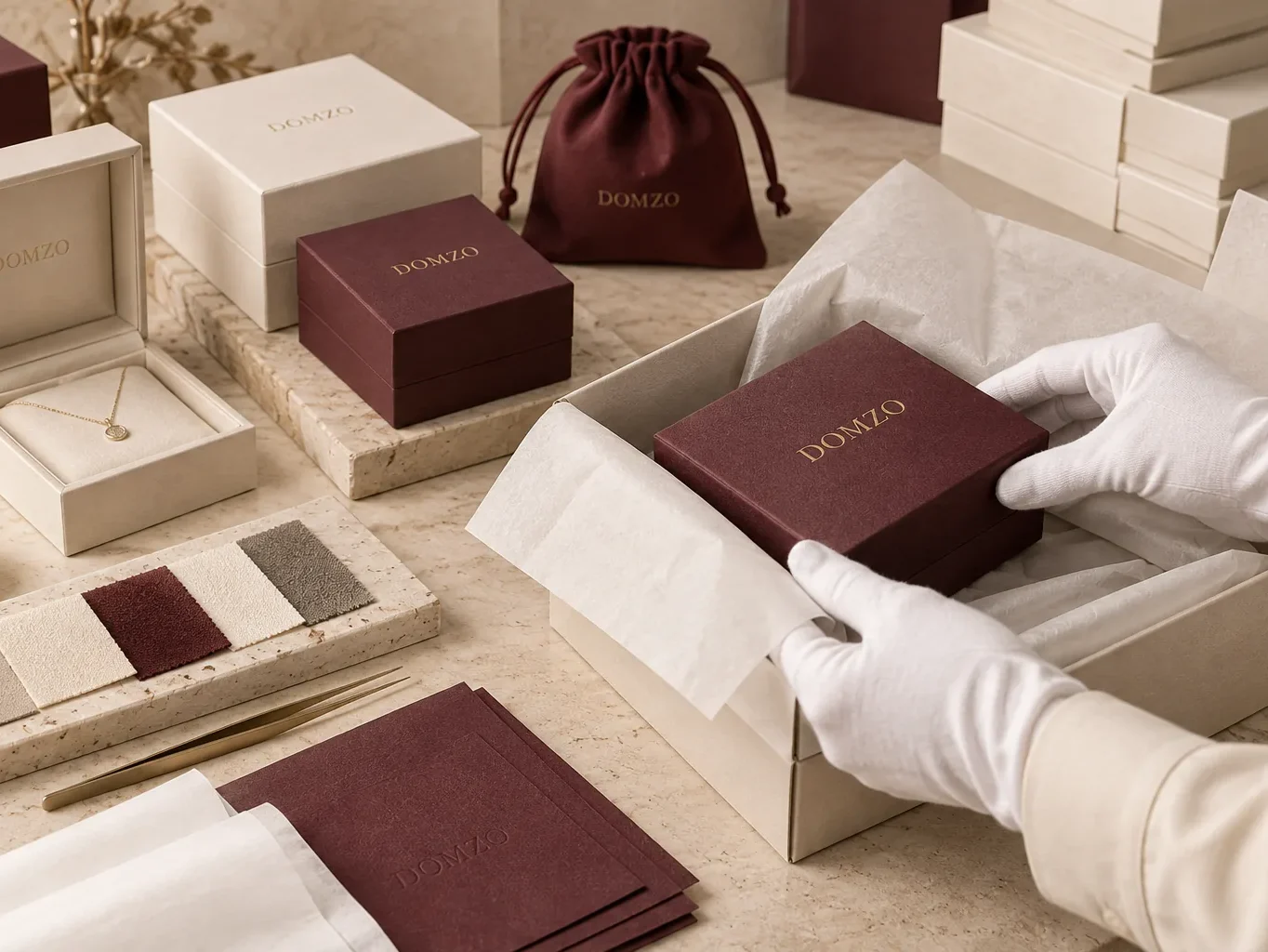
A pre-production sample helps confirm the structure, materials, logo and insert before bulk production.
What to Send for an Accurate MOQ and Quote
To receive a useful recommendation, send:
- Packaging type
- Finished size or jewelry dimensions
- Quantity for each style and size
- Logo artwork
- Preferred colors and materials
- Reference images or an existing sample
- Insert requirements
- Delivery country
- Target delivery date
If you do not know the final box size or material, send the jewelry dimensions, product type and visual direction. DOMZO can recommend a suitable starting point.
Frequently Asked Questions
What is the MOQ for custom jewelry boxes?
The standard MOQ for rigid jewelry boxes is 1,000 pieces per style and size. Selected rigid box projects may start from 500 pieces at a higher unit price. Folding paper boxes normally start at 2,000 pieces, with selected projects possible from 1,000 pieces.
What is the MOQ for custom jewelry pouches?
The standard MOQ for fabric pouches is 2,000 pieces per style and size. Selected projects may start from 1,000 pieces at a higher unit price, subject to the fabric, size, color and logo method.
What is the MOQ for custom paper bags?
The standard MOQ for custom paper bags is 3,000 pieces per style and size. Selected projects may start from 1,000 pieces at a higher unit price.
Can different box sizes be combined to meet one MOQ?
Normally, MOQ is calculated per style and per size because each size requires separate production preparation and inserts. Share the full size list so the complete program can be reviewed.
Can I approve a sample before production?
Yes. A pre-production sample can be made to confirm the packaging structure, dimensions, material, logo and insert. Typical sampling time is 7–10 days.
Where does DOMZO supply custom jewelry packaging?
DOMZO serves jewelry brands in North America, Central America, Europe, the Middle East, Korea and Southeast Asia. Shipping options are arranged according to the order and destination.
Plan the Right Quantity for Your Packaging
The best MOQ is the quantity that balances unit cost, inventory risk, packaging consistency and your expected sales. Send DOMZO the product type, size, quantity, logo and delivery country, and we will review the most suitable production starting point for your project.